

One Detail That Often Surprises People
When most people think about installing the Hercules M30 bollard or another crash-rated bollard, they picture a heavily reinforced concrete foundation with a cage of steel rebar extending below grade.
That’s why one detail in the Hercules M30 Set & Pour Bollard installation process often comes as a surprise:
No foundation rebar is required.
At first glance, that may seem counterintuitive. After all, crash-rated bollards are designed to withstand significant impact forces, so it’s reasonable to assume additional reinforcing steel would be required throughout the foundation.
The Hercules M30 takes a different engineering approach.
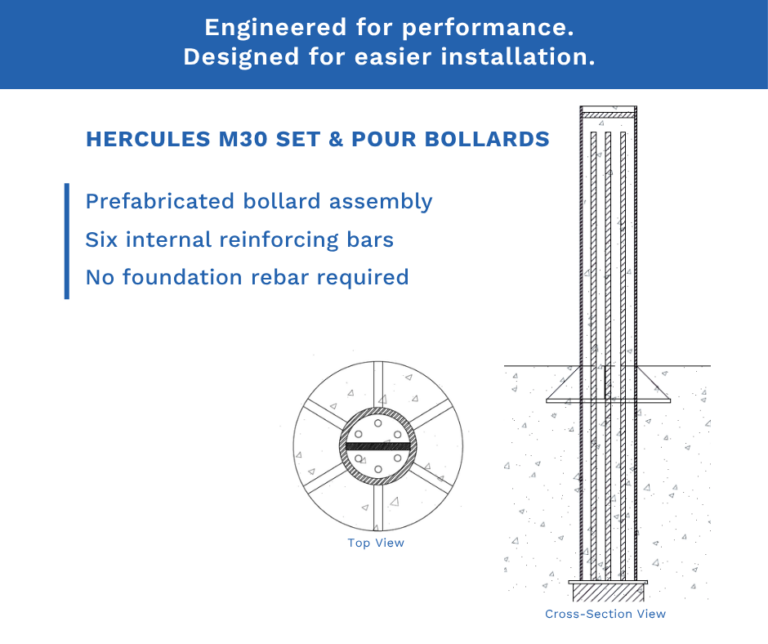
Rather than placing reinforcing steel in the concrete foundation, the structural reinforcement is concentrated inside the prefabricated bollard assembly. Six #6 reinforcing bars are inserted into the 8-inch Schedule 120 steel bollard tube before the bollard tube and surrounding excavation are filled with concrete.
The result is a design that simplifies installation while maintaining certified ASTM F2656 M30-P1 performance.
What Is Foundation Rebar?
Concrete performs exceptionally well under compression but is significantly weaker in tension. Reinforcing steel, commonly referred to as rebar, is added to concrete foundations to help resist tensile forces, improve structural performance, and control cracking.
Because of this, reinforcing steel is often associated with heavy-duty foundations and structural applications. It’s also one reason many people assume every crash-rated bollard requires a reinforced concrete foundation below grade.
It’s a logical assumption.
When a vehicle impacts a crash-rated bollard, tremendous forces must be transferred safely through the entire system. It’s easy to assume a large reinforced concrete foundation beneath the bollard is what absorbs them.
The reality is that crash-rated performance is achieved through the engineering of the complete system, not any single component alone.
How Is the Hercules M30 Different?
Instead of relying on reinforcing steel within the foundation, the Hercules M30 integrates its reinforcing bars directly into the prefabricated bollard assembly. This approach relocates the reinforcement from the foundation into the bollard itself, eliminating the need for foundation rebar while preserving the tested installation configuration.
This approach isn’t about using less engineering.
It’s about placing the reinforcement where it has been engineered to perform as part of the complete crash-rated system.
Why Does This Simplify Installation?
One of the most practical advantages of this design becomes apparent during installation.
Without foundation rebar to fabricate and position, installers begin by excavating the foundation, placing the prefabricated bollard assembly, inserting the six reinforcing bars, and then filling both the bollard tube and excavation with concrete.
Eliminating foundation rebar reduces field preparation and removes one of the more labor-intensive steps commonly associated with reinforced concrete foundations.
The result is an installation process that is quicker, cleaner, and more efficient while maintaining the engineering principles required for a crash-rated bollard system.
For contractors and project teams working to keep projects on schedule, this streamlined installation process can translate into meaningful time savings and improved jobsite efficiency.
Installation Overview
- Excavate and tamp the subgrade.
- Position the prefabricated bollard assembly.
- Insert the six #6 reinforcing bars.
- Fill the bollard tube and excavation with concrete.
- Finish the installation.
Does Eliminating Foundation Rebar Reduce Performance?
It’s a fair question. The answer is no.
The Hercules M30 is certified to ASTM F2656 M30-P1, demonstrating that its performance is based on the engineering of the complete system.
The heavy-wall steel pipe, internal reinforcing bars, concrete fill, foundation dimensions, and installation configuration all work together as the certified crash-tested assembly.
Crash-rated performance isn’t determined by a single design element. It’s achieved through the interaction of every component within the system.
The Hercules M30 demonstrates that thoughtful engineering can improve constructability without compromising certified performance.
Certified Performance
ASTM F2656 M30-P1
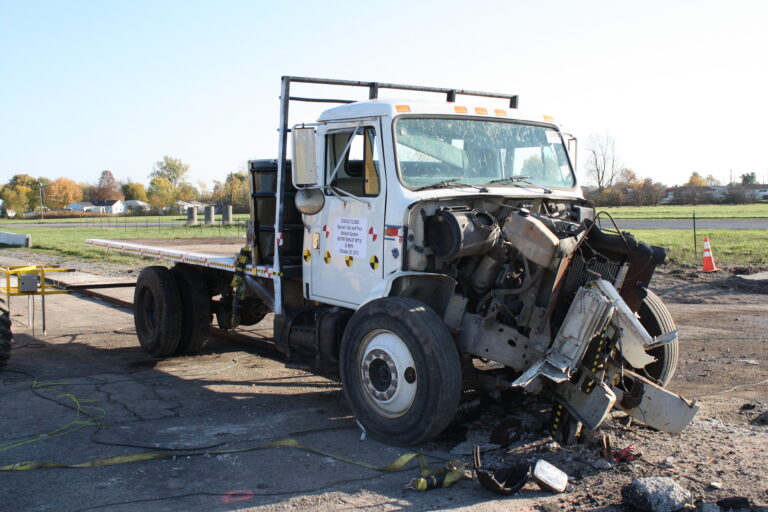
Certified to ASTM F2656 M30-P1 by stopping a 15,000-pound vehicle traveling at 30 mph with P1 penetration (less than 3.3 feet).
Certification is based on the performance of the complete tested system, including the steel bollard pipe, internal reinforcing bars, concrete fill, foundation dimensions, and installation configuration.
Typical Applications
The Hercules M30 Set & Pour Bollard is well suited for facilities where both security and installation efficiency are important considerations.
Typical applications include:
- Government facilities
- Military installations
- Critical infrastructure
- Utility sites
- Commercial campuses
- Transportation facilities
Wherever vehicle mitigation is required, a more efficient installation process can help reduce construction complexity while maintaining confidence in the finished system.
Why This Design Matters
It’s easy to compare crash-rated bollards by looking only at their certifications, dimensions, or specifications.
Those details are certainly important—but they don’t tell the entire story.
Sometimes the most meaningful engineering decisions are the ones that make installation easier without compromising performance.
The Hercules M30 Set & Pour Bollard is one example of that philosophy.
By integrating structural reinforcement into the prefabricated bollard assembly instead of the foundation, the system reduces installation complexity while delivering certified ASTM F2656 M30-P1 performance.
Thoughtful engineering isn’t always obvious.
Sometimes it’s found in the details below ground.
Frequently Asked Questions
Does the Hercules M30 require foundation rebar?
No. The Hercules M30 is engineered with six internal #6 reinforcing bars inside the prefabricated bollard assembly, eliminating the need for reinforcing steel within the concrete foundation.
Does eliminating foundation rebar reduce crash performance?
No. The Hercules M30 is certified to ASTM F2656 M30-P1. Certified crash performance is achieved through the engineering of the complete system rather than any single component.
Why are the reinforcing bars placed inside the bollard?
The reinforcing bars are integrated into the prefabricated bollard assembly as part of the engineered crash-rated system, eliminating the need for foundation rebar.
What are the installation benefits?
Eliminating foundation rebar helps simplify installation by reducing field preparation, minimizing foundation reinforcement, and creating a quicker, cleaner, and more efficient installation process.