
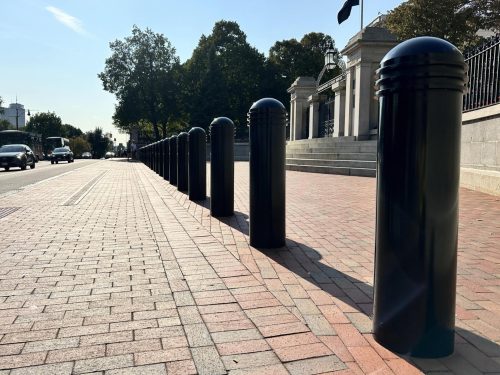
At Barrier1 Systems, our bollards are designed with protection in mind. Our crash-tested vehicle barriers help protect people and businesses from damage and are engineered and certified in accordance with ASTM standards. Proper installation should always take into account applicable local building codes and accessibility guidelines to ensure safety and compliance.
This commitment extends across our full product line, including:
- Safety bollards
- Shallow mount bollards
- Super shallow mount bollards
- Set and pour bollards
- Retractable bollards
The Major Bollard Code Requirement Systems (IBC, ADA, ASTM)
There are three common references that influence how bollards are specified and installed on projects. For example, the International Building Code (IBC) offers general protection guidelines for structures and pedestrian areas. The Americans with Disabilities Act (ADA) ensures that bollards are placed so that they don’t cause accessibility problems. The American Society of Testing and Materials (ASTM) ensures that bollards are structurally capable of withstanding vehicle impacts. Here’s a more detailed breakdown of each:The International Building Code (IBC) Code Requirements
The International Building Code (IBC), developed by the International Code Council (ICC), provides general guidance for protecting pedestrian areas and building elements from vehicle impacts. While bollards are not specifically named in the code, many local and state jurisdictions reference IBC provisions when determining general safety or spacing requirements for barriers.
While precise specifications aren’t outlined for bollards, most jurisdictions require these basic parameters:
- Minimum height: Typically 36 to 48 inches above grade
- Embedment depth: Commonly 3 to 5 feet set within reinforced concrete
- Spacing: Usually 3 to 5 feet apart to prevent vehicle passage
Americans with Disabilities Act (ADA) Code Requirements
Because bollards are often installed in areas accessible to the public, project designers and installers must also ensure compliance with accessibility guidelines established under the Americans with Disabilities Act (ADA). The following recommendations outline common ADA considerations for bollard placement and spacing:| ADA Specification | Specifications | Code/Guidance |
|---|---|---|
| Width | Should allow a minimum of 36 inches between bollards | Barriers must allow for wheelchair passage into and out of the protected area |
| Protrusion | Objects may project no more than four inches into the walkway | No object can project into walkways that might inhibit passage, typically between 27 and 80 inches from ground level |
| Detectability | Tactile surfaces, surface indicators, or color contrast should be implemented | Bollards should be visually detectable and include tactile features for those with visual impairments |
| Surface Placement | The base of the bollard must be flush or beveled to avoid trip hazards | Bollards should not impede or interfere with accessible walking surfaces |
While ADA guidelines help ensure accessibility and safe pedestrian passage, they do not determine the required spacing for crash-rated installations. To maintain the integrity of ASTM crash certification, bollards must be installed according to the manufacturer’s tested spacing and foundation specifications. Site designers should coordinate both accessibility and impact-resistance requirements during planning.
The American Society of Testing and Materials (ASTM) Bollard Code Requirements
ASTM International publishes performance testing standards that define how bollards and other vehicle barriers are evaluated for impact resistance. The two most commonly referenced standards for crash-rated bollards are ASTM F2656 (high-security, anti-ram barriers) and ASTM F3016 (low-speed safety barriers). Their key parameters are summarized below:| ASTM Standard | Vehicle Weight Classes | Test Speeds (mph) | Penetration Ratings |
|---|---|---|---|
| ASTM F2656 | Small cars (SC) – ~2,430 lbs Full-size sedans (FS) – ~4,630 lbs Pickup trucks (PU) – ~5,070 lbs Medium-duty trucks (M) – ~15,000 lbs Class 7 cabovers (C7) – ~15,873 lbs Heavy goods vehicles (H) – ~65,000 lbs | 30, 40, 50, 60 | P1: ≤ 3.3 ft (1 m) P2: 3.31–23 ft (1.01–7 m) P3: 23.1–98.4 ft |
| ASTM F3016 | Up to 5,000 lbs (SUV or full-size pickup) | 10, 20, 30 | P1: ≤ 1 ft P2: 1–4 ft |
Bollard Requirements in the Top 10 Largest U.S. Cities
Bollard code requirements come from a wide array of sources, such as governmental organizations, industry standards, and local building regulations. When determining how a bollard project adheres to code requirements, it’s critical to recognize that each authoritative body, which includes federal, state, and local governments, may have different rules and standards. However, as is made clear by the following table, many codes in some of the country’s largest cities cover several core aspects of bollard design, with requirements being relatively uniform:| City | Minimum Height Requirement | Spacing Requirement | ASTM Standard |
|---|---|---|---|
| New York City | 36 inches | 3 to 5 feet apart | ASTM F2656 |
| Los Angeles | 36 inches | 3 to 5 feet apart | ASTM F2656 |
| Chicago | 30 inches* | 3 to 5 feet apart | ASTM F2656 |
| Houston | 36 inches | 3 to 5 feet apart | ASTM F2656 |
| Phoenix | 36 inches | 3 to 5 feet apart | ASTM F2656 |
| Philadelphia | 36 inches | 3 to 5 feet apart | ASTM F2656 |
| San Antonio | 36 inches | 3 to 5 feet apart | ASTM F2656 |
| San Diego | 36 inches | 3 to 5 feet apart | ASTM F2656 |
| Dallas | 36 inches | 3 to 5 feet apart | ASTM F2656 |
| San Jose | 36 inches | 3 to 5 feet apart | ASTM F2656 |
The Organizations That Create and Enforce Bollard Codes
Understanding bollard code requirements can be complex, as they originate from multiple levels of regulation. While Barrier1’s bollards are crash-tested and certified to meet ASTM performance standards, project teams must also consider additional codes and guidelines established at the following levels:
- Federal – Requirements issued by agencies such as the Department of Homeland Security (DHS), Department of Transportation (DOT), General Services Administration (GSA), and the Department of Justice (DOJ) under the Americans with Disabilities Act (ADA).
- State – Standards from departments of transportation and state building code agencies, typically addressing roadway and infrastructure safety.
- Local / Regional – Ordinances and requirements from municipalities, planning departments, fire or police authorities, and port or airport commissions.
The Federal Level
At the federal level, bollard-related requirements and standards are typically guided by agencies such as the Department of Homeland Security (DHS), General Services Administration (GSA), Department of Transportation (DOT), and the Department of Justice (DOJ) under the Americans with Disabilities Act (ADA).
DHS and GSA guidelines are primarily applied to federal facilities and critical infrastructure projects, where consistent anti-ram and perimeter protection measures are required to safeguard personnel and property from potential vehicle attacks or accidents.
DOT publications and manuals, on the other hand, provide engineering guidance related to roadway design, pedestrian protection, and crashworthiness for federally funded transportation projects.
In addition, ADA compliance is mandatory for all public accommodations to ensure accessibility. The ADA, enforced by the DOJ, establishes requirements for accessible design and pedestrian pathways—ensuring that protective elements like bollards do not obstruct mobility or create barriers for individuals with disabilities.
The State Level
Each state maintains its own departments and agencies that influence bollard installation and design requirements. State Departments of Transportation (DOTs) commonly establish standards for protective barriers near highways, bridges, and pedestrian zones, particularly where vehicle access and public safety intersect.
Typical applications that fall under state-level oversight include:- Highway and rest area projects
- Bridge and tunnel approaches
- Transit stops and park-and-ride facilities
- Public service plazas or transportation hubs
The Regional/County Level
At the local level, municipal and county jurisdictions may establish specific requirements for bollard placement, spacing, and appearance to meet both safety and aesthetic goals. While few local transportation agencies directly regulate bollards, several other departments may play a role in approval and enforcement.
These often include:
- City planning and zoning departments
- Municipal engineering departments
- Fire and police departments
- Port authorities and airport commissions
- Historic preservation or architectural review boards