
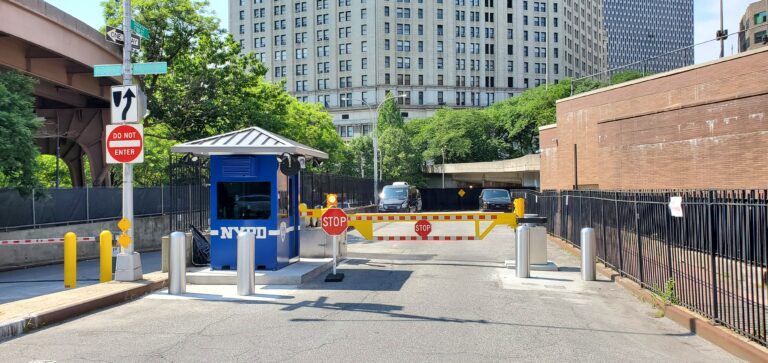
When planning a perimeter security project, one of the first decisions you’ll make is whether your facility requires active vs passive vehicle barriers. Active vehicle barriers can be operated or deployed in response to access or security requirements, while passive vehicle barriers remain fixed to provide continuous protection. Both play an important role in hostile vehicle mitigation (HVM) strategies, and many facilities use a combination of the two.
The distinction between active and passive barriers relates to how they function within the perimeter—not necessarily the level of protection they provide. Both active and passive barriers can be crash rated. In most applications, the primary consideration is whether the protected barrier line needs to accommodate vehicle access. Once that is established, factors such as the required level of protection, opening width, site conditions, and operating requirements can help determine the specific barrier system.
Key Takeaways
- Active vehicle barriers can be operated or deployed to allow or deny vehicle access.
- Passive vehicle barriers remain fixed and provide continuous protection.
- Both active and passive vehicle barriers can be crash rated.
- Many facilities use both as part of a layered perimeter security strategy.
What Is an Active Vehicle Barrier?
An active vehicle barrier is a barrier system that requires operation or deployment as part of controlling vehicle movement or responding to a security condition. Depending on the system, the barrier may raise, lower, swing, retract, or deploy across a roadway.
Unlike fixed barriers, active vehicle barriers can be operated or deployed in response to changing site conditions or security requirements. Some are used routinely to control authorized vehicle access, while others are intended to deploy only during elevated security events or an attempted vehicle intrusion.
For example, retractable bollards may be raised and lowered throughout the day to accommodate authorized vehicles, while vehicle arrestor net systems are often installed as final denial barriers and are intended to deploy only when a vehicle bypasses other layers of security.
When Should You Use an Active Vehicle Barrier?
Active vehicle barriers are used where the protected barrier line must be capable of opening or changing position, typically to accommodate authorized vehicle access. They may also be used as deployable final denial systems that remain in a standby position until a security event occurs.
Common applications include military installations, government facilities, airports, utility and energy facilities, data centers, corporate campuses, ports and maritime facilities, and other critical infrastructure sites.
Common Types of Active Vehicle Barriers and Their Applications
| Barrier Type | Commonly Used When... |
|---|---|
| Retractable Bollards | Authorized vehicles require controlled access through an opening while bollards provide protection when raised. |
| Wedge Barriers | A roadway or controlled entry point requires a deployable barrier across the vehicle path. |
| Crash Beams | A wide vehicle opening requires a powered horizontal barrier and the site can accommodate a system that deploys from below grade. |
| Vehicle Arrestor Net Systems | A deployable final denial barrier is needed to stop an unauthorized vehicle after it has bypassed or breached other layers of security. |
| Swing Arm Barriers | A surface-set, manually operated solution is appropriate, a wider span is required, and sufficient roadway clearance is available for the arm to swing open. |
| Drop Arm Barriers | A surface-set horizontal barrier is preferred for a controlled vehicle opening and either manual or powered operation is appropriate for the site's needs. |
| Vehicle Security Gates | Vehicle access must be controlled through a perimeter opening while maintaining a physical security boundary with the surrounding fence or barrier system. |
What Is a Passive Vehicle Barrier?
A passive vehicle barrier is a fixed barrier that does not require operation to provide protection. Once installed, it remains in place and continuously restricts vehicle movement into the protected area.
Passive barriers are commonly used along perimeter lines, around buildings and pedestrian areas, and anywhere vehicles do not need to pass through the protected boundary. Because they do not have to open or deploy, passive systems provide continuous protection without relying on an operator or activation sequence.
When Should You Use a Passive Vehicle Barrier?
Passive vehicle barriers are generally appropriate when permanent protection is needed and vehicles do not require access through the protected barrier line. They can help define a secure perimeter, protect vulnerable building approaches, separate vehicles from pedestrian areas, and prevent vehicles from bypassing active entry points.
Common Types of Passive Vehicle Barriers and Their Applications
| Barrier Type | Commonly Used When... |
|---|---|
| Fixed Bollards | Permanent vehicle restriction is needed while maintaining pedestrian access and visibility through the protected area. |
| Post and Cable Barriers | Longer sections of perimeter require continuous vehicle protection with a system capable of following the site's boundary or terrain. |
| Security Fencing | Vehicle mitigation and perimeter fencing need to function as an integrated system, providing both a defined security boundary and protection against vehicle intrusion. |
Active vs. Passive Vehicle Barriers at a Glance
| Consideration | Active Vehicle Barriers | Passive Vehicle Barriers |
|---|---|---|
| Operation | Operated or deployed as conditions require | Remain fixed in place |
| Vehicle Passage | Designed to create or secure an opening when needed | Used where vehicle passage through the protected line is not required |
| Typical Role | Controlled vehicle access or deployable final denial | Continuous perimeter or area protection |
| Operation Method | May be manual or powered | No operation required after installation |
| Crash-Rated Options | Yes | Yes |
Can Both Active and Passive Vehicle Barriers Be Crash Rated?
Yes. Both active and passive vehicle barriers can be crash rated. The terms active and passive describe how a barrier operates or is used, while a crash rating describes its tested impact performance.
ASTM F2656 is a primary U.S. crash-testing standard for vehicle barriers and includes performance classifications applicable to both active and passive barrier systems. Not every active or passive barrier is crash rated, so the specific product, tested configuration, impact condition, and penetration rating should be verified when crash-rated protection is required.
How Do You Choose Between Active and Passive Vehicle Barriers?
The primary consideration when choosing between an active and passive vehicle barrier is whether vehicles need to pass through the protected barrier line.
Choose a passive vehicle barrier when permanent protection is needed in an area where vehicles do not require access. Fixed bollards, post-and-cable systems, and crash-rated security fencing can provide continuous protection without needing to be opened, closed, or deployed.
Choose an active vehicle barrier when the protected opening must accommodate authorized vehicle passage or when a deployable barrier is required. Depending on the application, this may include retractable bollards, wedge barriers, drop or swing arms, crash beams, vehicle security gates, or final-denial systems such as vehicle arrestor nets.
Once that fundamental decision has been made, factors such as the required level of protection, opening width, available foundation depth, operating frequency, and site conditions can help determine which specific active or passive barrier is best suited to the application.
How Do Active and Passive Vehicle Barriers Work Together in a Layered Perimeter Security Strategy?
Active and passive vehicle barriers are often used together as part of a layered perimeter security strategy. Passive barriers provide continuous protection along areas where vehicle access is not required, while active barriers protect designated vehicle access points.
For example, crash-rated security fencing and fixed bollards may protect the perimeter surrounding an entrance, while a wedge barrier, retractable bollards, or vehicle security gate controls access through the roadway. In higher-security applications, a deployable final-denial barrier, such as a vehicle arrestor net, may provide an additional layer of protection farther inside the facility.
Frequently Asked Questions
What is the main difference between active and passive vehicle barriers?
Active vehicle barriers can be operated or deployed, while passive vehicle barriers remain fixed. The primary distinction is whether the barrier must change position or be deployed as part of controlling or denying vehicle movement.
Can both active and passive vehicle barriers be crash rated?
Yes. Both active and passive vehicle barriers can be crash rated. Active and passive describe how a barrier operates or is used, not whether it has been crash tested. Not all active or passive barriers are crash rated, so the specific product and tested configuration should always be verified when crash-rated protection is required.
Are active vehicle barriers always powered?
No. Active vehicle barriers may be manually operated or powered, depending on the barrier type and application. Powered systems may use electric, hydraulic, or hybrid actuation, while some active barriers can be operated manually. The defining characteristic of an active barrier is that it can be operated or deployed, not how it is powered.
Can active and passive vehicle barriers be used at the same facility?
Yes. Active and passive vehicle barriers are frequently used together as part of a layered perimeter security strategy. Passive barriers can provide continuous protection along the perimeter, while active barriers control vehicle access through designated entrances.
Which vehicle barrier is right for my facility?
Start by determining whether vehicles need to pass through the protected barrier line. If they do, an active barrier is generally required at that opening. If they do not, passive protection may be appropriate. The required level of protection, opening width, site conditions, operating requirements, and other project-specific factors can then help determine the appropriate barrier system.
Need Help Selecting the Right Vehicle Barrier?
Choosing between active and passive vehicle barriers starts with understanding how the protected area must function. The right system should support the facility’s security objectives while accommodating vehicle access, site conditions, operational requirements, and the required level of protection.
Barrier1 Systems offers active and passive vehicle barrier solutions for a wide range of perimeter security applications. Our team can help evaluate your site’s requirements and identify barrier options that align with your operational and security needs.