

Data center perimeter security demands a level of rigor that goes beyond fencing and cameras. These facilities serve as the operational backbone of financial systems, defense networks, healthcare platforms, and cloud services that billions of people depend on every day. As the value and visibility of data centers has grown, so has the threat landscape. Increasingly, that includes vehicle-borne threats: deliberate ram attacks, unauthorized vehicle access, and the catastrophic consequences of an uncontrolled vehicle breaching a facility perimeter.
For data center developers and owners, perimeter security planning cannot end at fencing and cameras. It requires a structured approach to vehicle access control, grounded in engineering performance, recognized certification standards, and threat-appropriate product selection.
The Physical Threat to Data Center Perimeters
A modern hyperscale or colocation data center represents a high-value, fixed target. These facilities house irreplaceable infrastructure and, in many cases, classified or sensitive data. Vehicle-based attacks, whether intentional or the result of loss of vehicle control, present a direct threat to personnel, buildings, and continuity of operations.
Perimeter fencing is the standard first layer of defense at data center facilities, establishing the property boundary and creating measurable delay against pedestrian intrusion. While crash-rated fencing systems exist and can provide vehicle resistance in certain configurations, most standard commercial fence installations are not rated to stop a vehicle traveling at speed. And regardless of fence specification, perimeter configurations will always include gate openings, service access points, and building approaches that require dedicated vehicle barrier protection.
This is where crash-rated anti-ram vehicle barrier systems become a required element of the perimeter security design, not an upgrade to it.
ASTM F2656: The Performance Benchmark for Anti-Ram Barriers
ASTM F2656 is the recognized standard for vehicle crash testing of perimeter security barriers in the United States. Published by ASTM International, this standard defines test conditions, including vehicle weight and speed, and measures the penetration distance of the test vehicle after impact.
Under ASTM F2656, barriers are rated by:
- Test vehicle class — Six vehicle classes are defined by weight, ranging from SC (Small Car, 2,430 lbs) through H (Heavy Goods Vehicle, 65,000 lbs). The M class (Medium Duty Truck, 15,000 lbs) is among the most commonly specified for critical infrastructure applications.
- Test speed — Expressed in miles per hour. Heavier vehicle classes are tested at 30, 40, and 50 mph; lighter classes are tested up to 60 mph.
- Penetration rating — Rated P1 through P3. P1 indicates minimal penetration of no more than 3.3 feet; P2 covers penetration from 3.31 to 23 feet; P3 covers 23.1 to 98.4 feet.
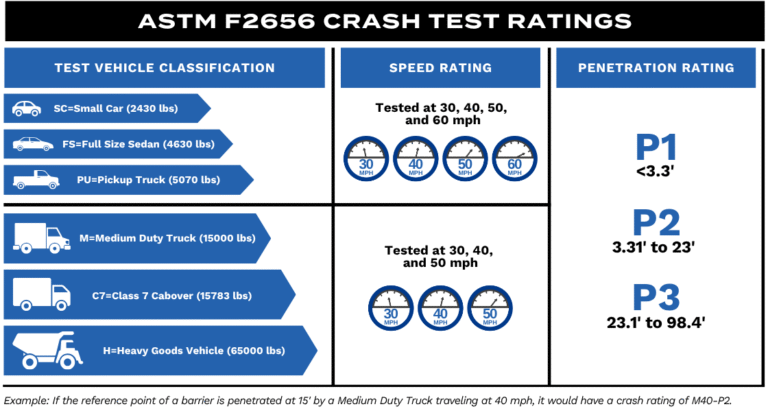
For data center applications, specifiers typically require M50 or M40 ratings at P1 or P2 penetration levels, meaning the barrier stops a medium-duty truck at speed with minimal incursion. The specific rating required depends on the threat model, standoff distance, and operational tempo of the facility.
Understanding these ratings allows architects, security engineers, and facility owners to match barrier performance to site-specific risk assessments rather than defaulting to products that simply look substantial.
Barrier System Types and Data Center Applications
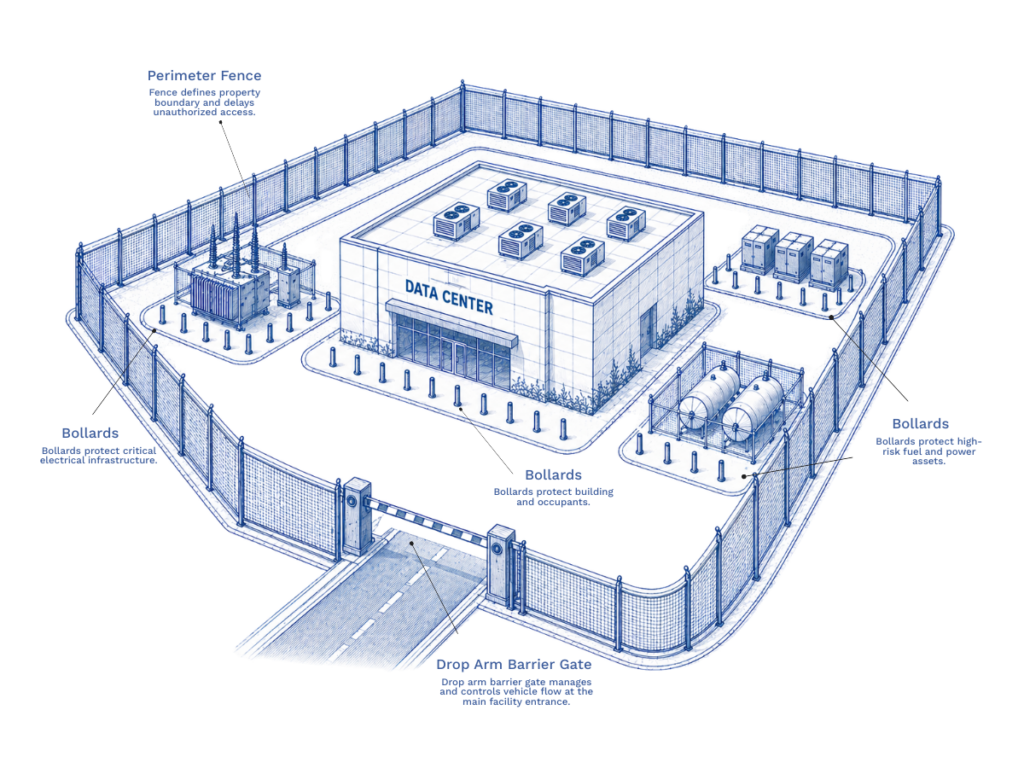
A well-designed data center perimeter integrates fencing with certified vehicle barrier systems at specific, high-consequence locations. Three barrier types address the primary vehicle threat scenarios at most commercial and critical infrastructure data center sites.
Fixed Bollards
Fixed bollards are the most widely deployed anti-ram solution at data center facilities. They provide passive, continuous vehicle protection at locations where vehicle access is not required but the threat of vehicle incursion is highest, including building facades, electrical transformer yards, generator pads, and fuel storage areas.
Because fixed bollards require no mechanical operation, they carry no cycle-rate limitations, no fail-state risks, and minimal maintenance requirements. For building envelope protection, a certified fixed bollard line is the most operationally dependable option available.
ASTM F2656-certified fixed bollard systems carry documented vehicle class and penetration ratings. Selection is driven by the threat vehicle profile and the standoff distance available between the bollard line and the asset being protected.
Retractable Bollards
Retractable bollards address locations where vehicle access is occasionally required but should not be unrestricted. Secondary access points, utility access lanes, and emergency vehicle staging areas are common applications at data center facilities.
In the raised position, a certified retractable bollard system provides the same vehicle-rated protection as a fixed installation. In the lowered position, it allows controlled vehicle passage. The ability to rapidly transition between states gives facility operators flexibility without compromising the certified protection level of the perimeter.
Retractable bollard systems specified for data center applications should be evaluated for operational cycle ratings, integration with access control and credential verification systems, and fail-secure versus fail-safe default states.
Drop Arm and Swing Arm Barrier Gates
Drop arm and swing arm barrier gates manage vehicle flow at primary access lanes, including main facility entrances, employee and visitor parking approaches, and loading dock access points. Crash-rated gate systems certified to ASTM F2656 stop unauthorized vehicle entry at controlled access points while maintaining the throughput required for daily facility operations.
Gate systems for data center applications must account for the high operational tempo of facility access. Cycle rates, integration with access control platforms, and reliability under continuous use are specification factors as important as crash-test rating. In a facility where continuity of operations is a core requirement, gate system reliability is not a secondary consideration.
Designing a Layered Perimeter: Principles for Data Center Developers
Effective perimeter security is not a product decision. It is a design discipline. For data center owners and developers approaching a new build or a perimeter upgrade, the following principles support sound barrier system planning:
Start with a threat and vulnerability assessment. Barrier selection should be informed by a documented assessment of the vehicle threat environment, including potential threat vehicle types, approach speeds, and attack vectors specific to the facility’s location and operational profile.
Define standoff distance requirements early. Standoff, the distance between the barrier line and the protected asset, directly affects the required barrier rating. Greater standoff generally allows more flexibility in product selection; constrained sites require higher-rated systems. This analysis belongs in the earliest phases of site planning.
Apply crash-test ratings to the right locations. Not every location on a data center perimeter carries the same risk level. Prioritizing certified barrier placement at primary vehicle access lanes, building facades, and critical infrastructure zones allows for efficient allocation of security investment without over-engineering low-risk areas.
Specify for integration, not just impact performance. Barrier systems at data centers operate within a broader security ecosystem that includes access control, video surveillance, and intrusion detection. Specifying barriers with documented compatibility for integration into security management platforms reduces friction during commissioning and long-term operations.
Account for maintenance and lifecycle. A barrier system that degrades or fails in service provides no protection. Certifications reflect performance at installation; maintenance requirements and manufacturer support determine whether a system continues to perform over the life of the facility.
The Standard for Environments Where Failure Is Not an Option
Data center perimeter security demands the same rigor applied to every other engineered system in the facility. Power redundancy, cooling, and physical access controls are specified to exact performance thresholds. Vehicle barriers should be no different.
ASTM F2656 crash-test certification provides objective, verifiable performance credentials that support defensible specification decisions. For developers, owners, and the security professionals advising them, these standards remove ambiguity from a decision that carries significant consequence.
Barrier1 Systems designs and manufactures ASTM F2656-certified anti-ram vehicle barrier systems, including fixed and retractable bollards and drop arm and swing arm barrier gates. All systems are U.S. engineered and manufactured.
If you are planning a data center perimeter or evaluating barrier options for an existing facility, contact us to discuss your project requirements today.